• Welcome to the BMW R18 Forums. Member registration disables ads and allows you to post and share. Register Here.

The R18 sidecar thread

  • <i class="fa--xf fal fa-check "><svg xmlns="http://www.w3.org/2000/svg" role="img" aria-hidden="true" ><use href="/data/local/icons/light.svg?v=1789222567#check"></use></svg></i> Discussion starter Discussion starter Petrus
  • Start date Start date
Today took the rig out for an easy spin. Well, as for as the R18 can ever be easy here in de mountains.

A rain shower again. In a normal summer is does not rain, period. This year we have the odd local showers. For the past 4-5 weeks basically once a day, Just a few minutes but big drops. Most in the evening, at night.
On both afternoon drives got wet though.
The streets are véry slippery with that water floating on the crap. It need REAL rain to clear/clean.
My point with all this: só good to be on the rig. Those things do not track straight anyway and on the wet they steer actually lighter :ROFLMAO:
 
ALL sidecar rigs are prone to low speed front wheel wobble.
It is rather gentle, occurs at a low speed range and it easy to mitigate.

The cause is the toe in.
Imagine the line of the wheels of the trcktor and that of the sidecar wheel.
It is easy to envisage that the distance gets closer, closer and closer the further you imagine ahead.
This is the course, the track, the front wheel and sidecar wheel follow.
Since the front wheel of the motorcycle is the steered one, its course is theoretically wandering inwards. It obviously cannot as it is part of the front suspension.
So there you have a situation that the front wheel steers inwards but is kept going straight by its mounting in fork/head stock.
The result is an increasing tension in the front fork and dito force outwards on the front tyre.
You can see the front fork as a spring being tensioned. Sooner or later the tension becomes larger than the grip of the front tyre and that steps sideways. This causes an oscillation = wobble.
At lower speed the tension stays lower and the tyre does not skip. At higher speeds the tyre rotates faster and the creep of the rubber is enough to negate the need for a skip.

It is good practice to fit a steering damper to slow down the oscillation and thus prevent the amplitude increasing. On modern rigs that is an hydraulic one.
I have fitted the OEM BMW one fitted on cruise control equipped bikes.
Depending on the rig and it´s set up, the wobble is more or less pronounced.

Also on most if not all rigs holding the handlebars creates an extra stabilizing force on the front suspension suppressing, raising the front tyre skip to the speed it creeps more/enough.
Next, changing the air pressure in the tyre will have effect. Normally slightly less will allow more deformation thus more creep.
Lastly putting slightly more rider/driver weight on the front will shift the frequency.

On my rig the tendency has decrease with the flat tread tyre. At the previous wobble speed the rubber has more grip so the skipping shifted to a slightly higher speed with more creep = less skip.

On my Vespa rig it basically is no issue with both hands on the steering because the the front wheel is only 10" diameter and the tyre creeps enough from low speeds but is does wobble and the mounting is scary flexible. Therefor I do have recently bought a minute hydraulic steering damper because the rig is already quite disconcerting enough for a passenger :ROFLMAO:
 
Yesterday, Sunday, morning and an elderly neighbor had expressed the wish to for ´churros with chocolate´ in the village up the road for her upcoming birth day. Loaded up in a car with her husband. Friend of mine in front on a Vespa and me behind with the R18 rig escorting.
She was chuffed to bits no need to say.
Apart from it being particularly lóvely on the rig as I donned light clothing only, the parked sidecar attracted lóts of attention again. Women too, including attractive ones swooning over it but as standard ´oh no :eek:´ about actually getting in.
Anyway, after we had concluded the ceremony my friend went on to fill his Vespa up and do some pottering about, and I just did the latter.
I find it so much more relaxing with the sidecar. Ok, physically more of an effort and you need to pay proper attention every meter but for one you are being noticed, séén. Secondly, you are being noticed, séén. Thirdly... 😅

@R2K how is it going?
 
So far good. I haven’t taken a passenger yet haven’t had good weather.
 
Yesterday great day riding Vespa the three of us. Even a dozen kms dirt roads because the local road was being resurfaced. Was very proud of my son.
So today was earmarked for the R18 rig. Was going out for lunch a few hours up the road. Son sent message that he wanted to come along passenger. 82 kgs fully dressed to ride.
My first proper drive with a passenger in the R18 rig.
The narrowest twistiests tracks with tarmac. Steep too, up to 18%.

Son got the hang of it. Literally :ROFLMAO:
We had unadulterated driving fun.

He took some getting used to the sidecar passenger not being a fixed part of the sidecar.
Some of the tighter corners need some specialized wrestling tricks tailored to going steep up or down.
The most unsettling he found me braking the front discs brusquely for a moment ´setting´ the rig to turn left, lightening my steering. He vividly shared the feeling of being propelled diagonally to the outside front of the tub.
The same on the throttle to the right he could not find the words for to express the sensation.

Now this sounds fast work but it was far from. The core was mostly second gear. It illustrates highlighted the unhinged nature of a traditional sidecar rig: The thing is an asymmetrical, fundamentally unbalanced most involving vehicle.
Read
and now add the derestricted R18 engine.
Seriously, this manual is both an entertaining ánd educational read.
I have four decades of rig driving experience and today´s fun has made me dig it out and re-re-reread some bits. Even if it is just confirmation it still adds.
 
Having some minor early life experience..... do you have specific hand grab spots so he can position himself in a very active way..... in Aussie land an "able passenger" would understand that by positioning themselves in a way to maintain a higher corner speed we would arrive at the pub (bar etc) sooner.... fitting at least one extra beer into the session..... this was always point 1 in any organised sidecar passenger training....and would always result in a diligent student.

So.... look corner, look cop then hang out or across....
 
The tub only allows for upper body movement and just a grab rail in front of the passenger. Still makes a notable difference. Not so much as me monkeying but still fun as it is coordinated team action.

A crucial aspect of cornering with a rig is the traction of the front tire. Because of the asymmetric non-allignment; p.e. toe it, the front tire always is pulling or pushing left/right, using up traction. The much commented upon ´heavy steering´ = using up front traction.
As such the situation for the centrifugal forces is vastly different from a solo bike or a car.
Now imagine going up a steep incline, weight transferring to the rear, lightening load on the front tire, reducing available traction and... tight left hander :eek:
No amount of leaning bodies will turn the rig at any decent speed. The trick is to go up/in too fast. Stick to the right, go deep, now while still pointing straight, grab a handful of front brake hard and brusque. Only momentarily but enough for more load on the tire and the tub to push the rig left. With the brake ungrabbed, steer left. Takes a bit of practice to get it coordinated in a swift action and it works better with a loaded chair than unloaded.

On a steep downhill left, the weight transfer and tub inertia/gravity pushing left can unload the rear enough to make it slide. The passenger and driver must keep the cog behind the tip over line.
The crux downhill is that gravity speeds up things FAST whereas uphill it is inherently aiding safety limits.
Braking while ín a downhill righthander is basically a NoNo and accelerating through a véry limited possibility.

Fun no?!
 
and... relief... received the 5 l. metal German made thus réal Jerry-can. The autonomy is nothing much riding solo and it goes down come 20% with the rig. Even though the fuel light pops up plenty early it does give range anxiety.
 
This afternoon out on the Nimbus sidecar. CanalSur TV was making a report on the colecionista event and I had organised about a dozen of classic vehicle to promote out event tomorrow.
Resulted to be a líve airing. The lady journalist started with the Nimbus (with the valves dancing of course :cool: ) and interviewed me. Yes sidecars are something special with the general public.
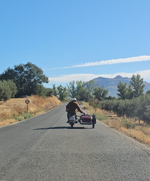
 
wow that was scary....

Nice weather... dûh... so out with the R18. On a réaly tricky section, narrow with tight blind corners where nigh everyone goes though too fast and the berms look like a bumper plastic cemetery, had a blow out of the front tire. One of those moments you are saved by experience.
Managed to ´park´ it where I could get the sidecar wheel fr enough in the scenery,
Called the recovery service and 1 hr. later had the rig at the tire place. Needs to wait there for a new inner tube.

The trick question is whether it being a rig sáved me from crashing or caused the issue. Whichever, it being rig kept me on the road and upright.
 
Last edited:
Bugga.....at least all worked out for you. So.... what's the theory of what caused it (Heidenau K28 sidecar tyre fitted a few weeks ago)..... did the heavy side loading see the tube pinched?
 
Bugga.....at least all worked out for you. So.... what's the theory of what caused it (Heidenau K28 sidecar tyre fitted a few weeks ago)..... did the heavy side loading see the tube pinched?
Most likely not perfectly mounted inner tube with possible for this tire to low OEM spec pressure. There is a rip at the valve in the inner tube.
 
Thanks for sharing @R2K

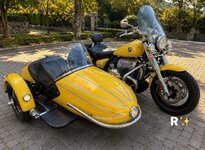
Looks much like yours. Not my first choice of color though. Over here it is the Correos (Post) color :oops:

Me, I am planning to go hands on tomorrow morning with the new inner tube. Want to get to the root cause.
Miss the rig: It is rather in my face in the apartment ánd I have been taking it out most days.
 
Last edited:
The inner tube was in Friday but I had other obligations so went at opening hour this morning. Took the wheel out, the mechanic took the tire off.
The inner tube had a 1 cm slit. Nothing in the tire. Weird. The 120/70 inner tube ís a bit small for the 4.00 tire.
The new extra heavy duty Michelin is larger but with 4 mm also over three times thicker rubber.

MICHELIN reinforced inner tube 4.00x19

The MICHELIN reinforced 4.00x19 inner tube is designed to offer greater resistance than conventional inner tubes. Thanks to its reinforced construction, it significantly reduces the risk of punctures, pinch flats, or deformation, particularly during off-road use, on stony paths, or during intensive use with a sidecar.

It is perfectly suited to classic, vintage, or trailer motorcycles using 4.00x19 tires. Michelin's manufacturing quality guarantees excellent longevity, stable tire pressure, and proven reliability.

This inner tube is ideal for motorcyclists looking for a compromise between safety and robustness, without upgrading to a more rigid super reinforced version.


Mechanic fit it, balanced the wheel.
I mounted the wheel.
Test drive all ok. Checked. Second ride a bit faster. All ok.
My conclusion is that the tire needs a bit more pressure.
Set it, fitted metal valve cap and turned the nut up against it. This locks the cap and allows the valve some movement which has the additional benefit that you can spot any turning of the tire on the rim.
Happy I have Heidi back :love:
 
Last edited:
About the tire pressure.
The front tire of a sidecar rig is the critical one.
Higher pressure is less understeer and vv. As such higher pressure results in more direct steering response.
Less pressure, thus more drift angle, reduces the sidecar wobble and vv. This does not mean more amplitude but it shifts to a slightly higher speed range and that reduces the amplitude because of faster turning tire, rubber.
Apart from that the air pressure is what keeps the tire on the rim. On a heavy rig such as the R18 you need the tire to hold on tight to the rim.

I have tried the OEM 2.5 bar, upped to 2.8, went down to 2.5 again (to verify findings) and am now on 3.0 although this is not completely comparable because of the different size.
 
Back
Top